


“I will forget unless you email me.”
“I’m not good with moderation.”
“I want to be a vegetarian.”
“I love the feeling of pond water.”
Before I go too much further, I’m not advocating any change or self-help or path to freedom or wellness. My lane these days is not necessarily about improving my or your life, but rather to explore how reality is made of stories. If I have a goal, it is to do that. And then you can do with it what you will. Sure, I’d love everyone to be more empathetic and connective and supportive, but ultimately I trust that everything is going as it should. Even the rough stuff.
Thank you for hanging with that disclaimer.
The thesis of this essay is that we craft our identities through predictions. I got a taste of this concept from a recent Plain English episode (always provoking podcast), but I can’t recall the psychological underpinnings. What I heard in the episode was that our sense of self is often a prediction of our behavior in the future. “I don’t like small talk” is generally said when small talk is on the horizon. You are predicting that you won’t like a small-talkish interaction at an upcoming party. You are imagining the small talk and your negative response and are thus declaring that you don’t like it RIGHT NOW.

Of course this prediction has research gathered from the past: that guy at the reunion who wanted to talk about the weather in Kansas in comparison with Iowa, or how concerning the political discourse is, or whatever you deem “small talk.” You recall the discomfort and are anticipating possibilities in the future.
But none of it is happening right now. No small talk is happening, but you are borrowing discomfort from the past and future. You are “storying” discomfort into your current state.
A little on storying:
Storying is the practice of creating a story in real time. When we story (verb) we tell ourselves and those around us a story about “what is so”. We aren’t measuring data or reading the news, we are making shit up. I’m not saying it is true or false, it is just what we are doing. We are real-time voicing our own interpretation about what is going on now, in the past, or in the future. “I’m fine” is a story. “I went to the grocery store” is a story. Again, not true, false, inaccurate or accurate. Simply what it is: an account.
Here is where this essay might sound a little like self help.
I offer this practice so that you can more successfully see the stories that dictate our reality and sense of self. The point is for you to see how the world is made of stories and then you can gain agency in how you relate to those foundational narratives.
We can also unstory.
What this means is that once we see the stories that we spool out all day long, the predictions we make about who we are and how we will feel and what we will do, we can make a choice. We can live into that story … or … we can change it. We can unstory it.
This is not based on any knowledge of psychology, this is based on my own experience.
The phrases at the top of this essay are things I have said to myself. They are predictions. “I love the feeling of pond water” is drawn from past experiences and a sense of delight when I imagine a future instance where I swim in the pond. I am not in the pond right now, I am sitting on my couch. I am not in water at all, but I am enjoying the feeling of the pond water. I am enjoying the prediction.
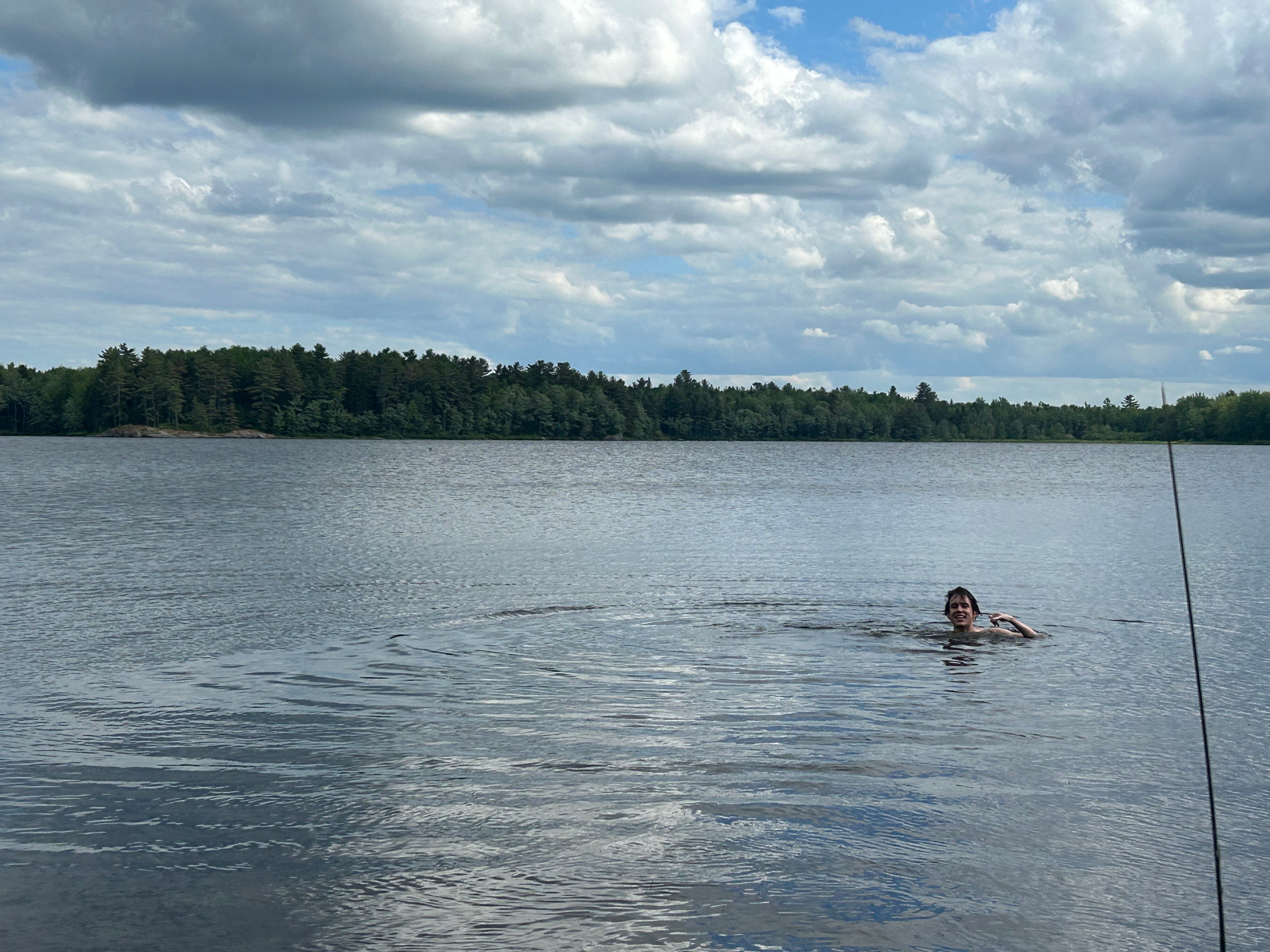
The feeling is happening, but none of it is “real.”
So if I wanted to unstory this, I would notice that none of it is real and then I would consciously tinker with the story. I’ll take out the loving and replace it with hating. “I hate the feeling of pond water.” Now my imagination is finding the gooey stuff at the bottom of the pond, the algae smell, wondering if there is a dead fish nearby, wondering if I will step on a mussel shell. Now I don’t want to be in the pond water. I want to get out, even though I am still on the couch. None of this has happened but my feeling has changed. And so has my personality. A moment ago, I loved the feeling of pond water, but now I hate it. And this was all because I unstoried the pond water feeling.
This works with the other stuff as well.
“My belly is too big.”
Let’s play with that one. I can try to rationalize that my belly is not too big, that I am actually in shape, that most men my age have bigger bellies than they used to, that all I needed to do was to get back into hot yoga regularly and my belly will shrink but the story remains. My belly will stay too big.
I can also unstory it. “I don’t care about my belly.” I immediately take the wind out of the story. Its fine. Its no big deal. Bellies are no big deal. I’m actually more interested in other things like how I feel better without eating this or that. I’m more interested in how my dog is doing. My belly isn’t really that important. And then boom, the belly concern is gone. I have unstoried it.

I suppose this is like affirmations, but I think there is a big difference. An affirmation is done with the intention to make change. Unstorying is a tool for whatever you want to do. Its a wrench. A nail puller. Again, my motivation is not to help you change your life but to show you that the world is made of story legos. It is all constructed out of little narratives that have our attention. I can have a reality that includes a big belly or not. I can have a reality that includes conspiracies or not. I can have a reality with dire global problems or not.
Whatever. But maybe try it out. It is as simple as this:
Notice a story you are telling and how it feels.
Change the story and notice how it feels.
Done, that’s the exercise. For me, however, it is the tool of tools. It is true alchemy. Gold or lead, up to you.
Hey, we are forming a new cohort of those interested in practicing these tools (Restorative Storytelling). Let me know if you want to try it out. First month is free. I’d love to meet you.
Writing stories and then looking backwards what the story was trying to tell you is THE most fulfilling experience to me and that brings change. I liked the term unstorying like in the learning, unlearning, relearning sequence❤️
I really like this prediction frame as a way of looking at the stories we tell ourselves. I see this in myself, the habit of reinforcing my boundaries, limits, and preferences as I approach a situation, person, or period of time—all as a way of defining or protecting in advance how I'll be with that approaching element.